Back
How Loyalty Programs Are Solving FMCG's Biggest Growth Challenge
How Loyalty Programs Are Solving FMCG's Biggest Growth Challenges by Increasing Customer Retention, Repeat Purchases, and Brand Loyalty
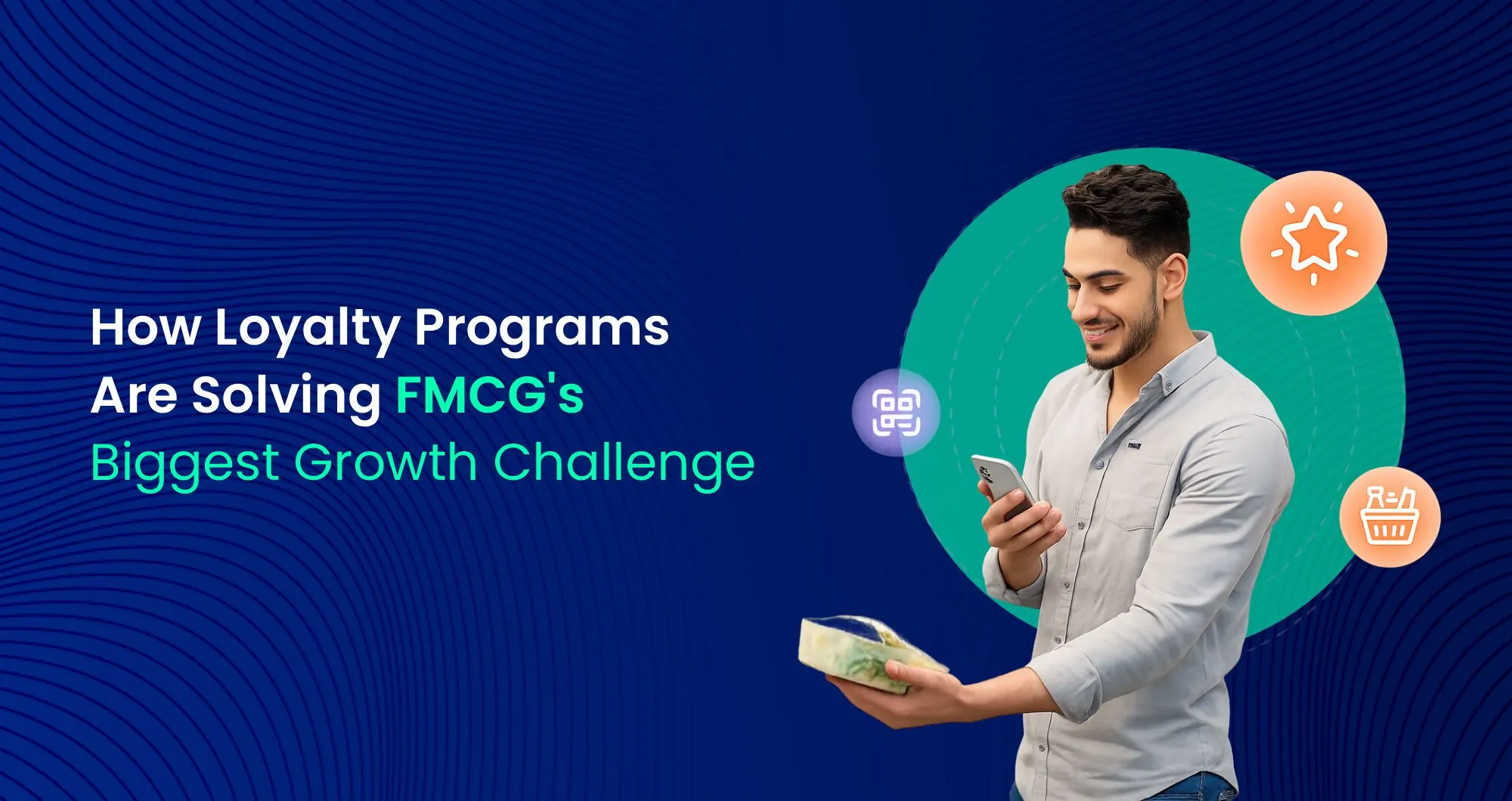
Every FMCG brand in India faces the same core tension: your product sits on a shelf next to three competitors that look almost identical, cost nearly the same, and make nearly identical promises. Your distributor pushes whatever moves fastest. Your retailer stocks whatever his customer asks for. And your consumer? She switches brands the moment her usual choice runs out of stock or the competitor runs a better scheme.
This is not a new problem. But it is getting harder to solve.
Distribution costs are rising. Trade margins are under pressure. Consumer acquisition through advertising alone is becoming expensive and less effective. And while everyone is chasing new customers, the real revenue opportunity sits in a question most FMCG brands fail to answer clearly: how do you get the same customer, the same retailer, and the same distributor to keep choosing you, again and again?
The answer, increasingly, is FMCG loyalty programs. Not the discount-led, scheme-heavy approach that has become the default across most of the industry, but structured, data-driven, digital loyalty programs that build real behavioral change across your entire value chain.
This article breaks down why loyalty programs are fast becoming the most important growth lever for FMCG brands in India, how they work across the full distribution chain, and what a modern, UPI-linked loyalty program looks like in practice.
We at Verify App work with FMCG brands, distributors, and retailers every day. What we see consistently is this: brands that invest in structured loyalty programs grow faster, retain their channel partners more effectively, and build stronger consumer recall than brands that rely on discounts alone.
1. Why FMCG Growth Is Getting Harder to Sustain
The Indian FMCG market is one of the most dynamic in the world. It is also one of the most competitive. Across categories like packaged foods, beverages, personal care, home care, and health products, the shelf is crowded and margins are thin.
Here is what makes sustained FMCG growth particularly difficult today:
a) Brand Switching Is the Default Consumer Behavior
Indian consumers, especially in Tier 2 and Tier 3 markets, are highly price-sensitive. When a brand runs a promotional discount, consumers switch. When the discount ends, they switch back, or switch to whoever is running the next offer. Brand loyalty in the traditional sense, the kind where a consumer refuses to consider alternatives, is rare in most FMCG categories.
This creates a cycle where brands spend heavily on promotions to spike short-term sales but fail to build the habit of purchasing their product. The moment the promotion ends, volume drops. The brand runs another promotion. The cycle repeats.
b) The Distribution Channel Drives Purchase Decisions
In India, the retailer and distributor sit between your brand and your consumer. Especially in general trade, which still accounts for the majority of FMCG sales in India, the kirana store owner influences what gets sold. If a retailer is not actively recommending your product, you are losing sales that no amount of consumer advertising will recover.
Distributor and retailer loyalty is not automatic. It is earned through margins, service quality, schemes, and increasingly, through structured loyalty programs that reward them for sustained engagement with your brand.
c) Schemes and Discounts Are Not Building Loyalty
Most FMCG brands run trade schemes: buy X cases, get Y free; purchase above a threshold, get a cash reward; stock our seasonal SKU, earn a gift. These schemes work in the short term. They move inventory. They incentivize loading.
But they are not building loyalty. They are buying temporary compliance. The moment a competitor runs a better scheme, your distributor pushes their product instead. There is no structural reason for them to stay committed to your brand.
d) Data Visibility Across the Value Chain Is Poor
Most FMCG brands have limited visibility into what is happening at the retailer and consumer level. They know how much stock they shipped to their distributor. They often do not know how much of that stock actually reached the retailer, how quickly it sold off the shelf, or what drove the purchase.
Without data, you cannot personalize your engagement, optimize your schemes, or identify which channel partners are genuinely loyal versus which ones are just gaming your promotions.
The root cause of FMCG's growth challenge is not a lack of marketing investment. It is a lack of structured engagement that builds real behavioral loyalty across the value chain. That is precisely what modern FMCG loyalty programs are designed to address.
2. What FMCG Loyalty Programs Actually Do
There is a common misconception that loyalty programs are simply reward points systems. Collect enough points, redeem for a discount. While points are one mechanism, a well-designed FMCG loyalty program does far more than that.
A loyalty program for FMCG brands is a structured engagement system that:
Identifies and rewards repeat purchase behavior at the consumer, retailer, and distributor level
Creates positive reinforcement loops that make your brand the habitual choice
Generates real-time data on purchasing behavior, channel performance, and brand recall
Reduces dependency on discounts by replacing price incentives with value incentives
Builds a direct communication channel between your brand and your stakeholders
The best loyalty programs work across all three levels of the FMCG value chain simultaneously: consumer loyalty, retailer loyalty, and distributor loyalty. Each level requires a different approach, but all three should be connected into a single, coherent strategy.
a) Consumer Loyalty: Building the Repeat Purchase Habit
At the consumer level, loyalty programs work by rewarding the behavior you want to see more of. For FMCG brands, that behavior is repeat purchase. Every time a consumer buys your product, they earn a reward, whether that is points, cashback via UPI, exclusive offers, or early access to new products.
Over time, this creates a habit loop. The consumer associates your brand with the positive experience of earning and redeeming rewards. The switching cost, which for most FMCG products is nearly zero, starts to feel higher because they have something to lose by buying a competitor's product.
b) Retailer Loyalty: Turning the Kirana Store Into Your Brand Ambassador
At the retailer level, loyalty programs change the incentive structure. Instead of one-off trade schemes, retailers earn ongoing rewards for consistent stocking, active recommendation, and achieving monthly purchase targets with your brand.
A well-designed retailer loyalty program for customer loyalty in FMCG creates a powerful dynamic: the retailer now has a financial and relationship reason to actively push your product over a competitor's. When a consumer asks for a product in a category, the retailer recommends yours. That recommendation, in a kirana store environment, often directly converts to a sale.
c) Distributor Loyalty: Aligning Channel Partners With Your Growth Goals
At the distributor level, loyalty programs reward consistent performance: achieving volume targets, expanding retail coverage, maintaining recommended pricing, and ensuring product availability in key outlets.
Distributor loyalty solutions that are tied to real performance data, rather than just reported numbers, create a much stronger alignment between your brand's growth goals and your distributor's commercial interests.
3. Why UPI-Linked Loyalty Programs Are the Right Fit for India
India's digital payment ecosystem has changed the rules of what is possible in loyalty and rewards. The widespread adoption of UPI, even among small kirana retailers and rural consumers, means that reward disbursement is no longer a logistical challenge.
Historically, one of the biggest friction points in trade loyalty programs was reward fulfilment. Brands would promise rewards, retailers would achieve targets, and then the process of actually delivering the reward, whether in cash, gifts, or credit notes, was slow, opaque, and prone to leakage. This eroded trust in loyalty programs across the FMCG channel.
UPI rewards for FMCG solve this problem directly.
a) Instant Disbursement Builds Trust
When a retailer achieves their monthly target and receives their reward directly in their UPI account within 24 hours, the program becomes credible. The feedback loop is immediate. The retailer sees the direct connection between their behavior and their reward, which reinforces the behavior you want.
Compare this to a trade scheme where the reward is a branded gift delivered weeks later, or a credit note that gets lost in paperwork. The motivational impact is not even comparable.
b) UPI Adoption Across Tier 2 and Tier 3 Markets
One of the concerns FMCG brands often have about digital loyalty programs is whether they will work in Tier 2, Tier 3, and rural markets. The UPI data makes this concern largely obsolete. UPI transactions now happen in villages across India. The small kirana owner who stocks your soap and biscuits almost certainly has a UPI-linked bank account and uses it regularly.
A UPI-based loyalty platform reaches these retailers effectively without requiring them to use an app, remember a PIN for a separate rewards account, or wait for physical reward delivery.
c) Transparency Across the Entire Program
UPI-linked rewards create a transparent audit trail. Every reward disbursed is traceable, timestamped, and linked to the specific behavior that triggered it. For FMCG brand managers and finance teams, this is a significant advantage. You know exactly what you spent on loyalty rewards, exactly which partners earned them, and exactly what behavior they were rewarding.
This transparency makes it far easier to measure your loyalty program's ROI and optimize it over time.
At Verify App, we have built our platform on UPI-first reward disbursement because we believe instant, transparent rewards are the only way to build genuine trust with your channel partners. A reward that arrives fast and reliably is far more motivating than a reward that arrives eventually, if it arrives at all.
4. The Real Economics of Loyalty vs. Discounts
One of the most important shifts in FMCG thinking that loyalty programs enable is the move away from discount-led growth. This deserves a careful examination because many FMCG brands are locked into a discount cycle that is actually destroying value over the long term.
a) The Hidden Cost of Discount-Led Growth
When you run a trade scheme offering 10% off for bulk purchases, you are effectively paying for volume. You get a short-term spike in sales. But what happens to your margin? What happens to your brand's price perception? What happens when the competitor matches your discount next month?
Discount-led growth has three fundamental problems for FMCG brands:
It trains your channel partners and consumers to wait for the next deal before buying
It erodes your margin without building any durable advantage
It creates a race to the bottom where the brand with the deepest pockets, not the best product, wins
b) How Loyalty Programs Improve Unit Economics
A well-structured loyalty program shifts the investment from price reduction to behavior reward. Instead of giving 10% off to everyone who buys above a threshold, you are rewarding your best, most consistent channel partners and consumers for their loyalty.
This has a very different economic profile. You are spending loyalty rewards on the behavior you want, which is consistent repeat purchase, not one-time volume loading. The retailer who buys consistently from you every month earns ongoing rewards. The retailer who buys once for a scheme and then disappears does not.
Over time, this creates a loyal core of channel partners and consumers whose lifetime value is significantly higher than occasional buyers. The cost of retaining a loyal retailer or consumer through a loyalty program is typically much lower than the cost of constantly acquiring or reactivating them through promotions.
c) Loyalty Programs Enable Smarter Scheme Design
An additional benefit of running a structured loyalty program is the data it generates. When you can see exactly which retailers are consistently buying, which SKUs are moving in which geographies, and which distributor territories are outperforming, you can design your trade schemes much more intelligently.
Instead of running blanket discounts across all markets, you can target your promotions at specific markets where you need to grow share, while using your loyalty program to maintain the engagement of markets where you are already strong.
5. Building a Loyalty Program Across the FMCG Value Chain
A loyalty program that only targets consumers while ignoring retailers and distributors will underperform. Equally, a program that only rewards distributors while ignoring the end consumer misses the consumer habit formation that drives long-term brand growth. The most effective FMCG loyalty programs are multi-tier and connected.
Here is how to think about structuring loyalty programs across each level of your distribution chain:
Level 1: Consumer Loyalty Programs
Your consumer loyalty program should be simple to join and immediately rewarding. The biggest barrier to consumer loyalty program adoption in FMCG is friction. If joining the program requires downloading a separate app, filling out a long form, or waiting too long for the first reward, most consumers will not bother.
Design principles for effective consumer loyalty in FMCG:
Make enrollment frictionless: a QR code on pack, a missed call, or a simple WhatsApp message to join
Deliver the first reward quickly to establish the value of the program
Make rewards tangible and meaningful: UPI cashback, free products, and exclusive offers work better than abstract points
Communicate regularly to keep your brand top of mind between purchases
Personalize rewards based on purchase history and category preferences
Level 2: Retailer Loyalty Programs
Your retailer loyalty program needs to be built around the retailer's commercial reality. The kirana store owner operates on thin margins and makes stocking decisions based on what he believes will sell and what his distributor recommends. Your program should give him a compelling financial reason to choose your brand consistently.
Design principles for effective retailer loyalty programs:
Set monthly or quarterly targets that are achievable and aspirational for each retailer tier
Reward consistently, not just at the end of long cycles
Disburse rewards via UPI for immediacy and trust
Use a tiered structure (Bronze, Silver, Gold) to incentivize retailers to grow their engagement with your brand
Include non-financial rewards like recognition, training, and visibility support for your top retail partners
Level 3: Distributor Loyalty Solutions
Your distributor loyalty program should focus on the behaviors that drive growth in their territory: expanding retail coverage, maintaining recommended pricing, achieving volume targets, and ensuring product freshness and availability.
Design principles for distributor loyalty solutions:
Tie rewards directly to measurable, verifiable performance metrics
Reward territory expansion and new retail onboarding, not just volume
Use real-time data to provide distributors with visibility into their performance against targets
Create an annual recognition program for your top distributors to build a long-term relationship
Use the program to communicate new product launches, seasonal schemes, and brand priorities directly to distributors
The most powerful FMCG loyalty programs we have seen at Verify App are the ones that connect all three levels into a single, coherent ecosystem. When your consumer buys, your retailer earns. When your retailer meets his target, your distributor is recognized. When the whole chain moves together, your brand grows sustainably.
6. Data: The Most Underrated Benefit of Loyalty Programs
Every FMCG brand manager wants better data. Better data on consumer behavior, on retail sell-through, on distributor performance, and on competitive dynamics. The challenge is that most traditional FMCG data sources are either lagged, incomplete, or expensive.
A well-run loyalty program solves this problem by generating real-time, first-party data as a natural by-product of the reward mechanism.
a) Consumer Behavior Data
When consumers participate in your loyalty program, you learn: how often they buy your product, which SKUs they prefer, in which stores they typically shop, and how they respond to different reward types and communication triggers.
This data is genuinely valuable. It tells you which consumer segments are most loyal, which products are driving repeat purchase, and where you are at risk of losing consumers to competitors. You can use this data to make your marketing more targeted, your new product development more consumer-driven, and your communication more personalized.
b) Retail Performance Data
Through your retailer loyalty program, you collect data on which retail outlets are consistently stocking your full range, which ones are buying erratically, and which ones are meeting their monthly targets. This data is often more granular and current than anything your sales team can report.
You can use retail performance data to identify your most valuable retail partners, target your van sales and merchandising efforts more effectively, and design geographically specific promotions for markets where you need to strengthen share.
c) Distributor Performance Analytics
At the distributor level, loyalty program data gives you a clear picture of territory coverage, volume consistency, and scheme compliance. You can quickly identify which distributors are expanding their retail network and which ones are stagnant. You can spot territories where competitor activity is impacting your sell-through.
This intelligence makes your distributor management far more proactive and data-driven, replacing gut feel with verified performance metrics.
7. Common Mistakes FMCG Brands Make With Loyalty Programs
Not every FMCG loyalty program succeeds. Many brands invest in loyalty programs and see disappointing results. In most cases, the failure is not because loyalty programs do not work. It is because the program was designed or executed poorly. Here are the most common mistakes to avoid:
Mistake 1: Designing a Program That Is Too Complicated
The more complicated your loyalty program is, the lower your enrollment and engagement rates will be. If a retailer needs to understand a multi-page scheme document to figure out how much she will earn, she will not engage. Simplicity is not just a design preference; it is a commercial necessity.
Mistake 2: Delaying Reward Disbursement
Every week of delay between a retailer or distributor achieving a target and receiving their reward costs you trust and engagement. In a market where competitors are running concurrent schemes, slow reward delivery is a serious competitive disadvantage. UPI-based instant disbursement is not optional; it is the baseline expectation.
Mistake 3: Running a One-Size-Fits-All Program
A small kirana in a Tier 3 town has very different purchasing patterns, category preferences, and reward preferences than a modern trade store in a Tier 1 city. Running the same program for both is inefficient. Effective loyalty programs segment their participants and tailor rewards, targets, and communication accordingly.
Mistake 4: Treating Loyalty as a Scheme, Not a Strategy
Many FMCG brands treat loyalty programs as one more quarterly scheme, run it for a season, measure short-term volume uplift, and move on. Loyalty is a long-term strategy. The compounding benefits of a loyalty program, deeper relationships, better data, stronger brand recall, take time to materialize. Brands that shut down their programs too early never realize these benefits.
Mistake 5: Not Communicating Enough With Program Members
A loyalty program that goes silent between purchase cycles loses its influence on behavior. Regular, relevant communication keeps your brand top of mind and reminds your retailers and consumers of the value they are accumulating. Use WhatsApp, SMS, and app notifications to stay connected.
8. How Verify App Powers FMCG Loyalty Programs
At Verify App, we have built a UPI-based loyalty, rewards, and customer engagement platform specifically designed for the realities of the Indian FMCG market. We understand that your distribution network spans Tier 1 metros and rural villages. We know that your channel partners range from sophisticated modern trade buyers to small kirana owners who process everything on a basic Android phone.
Our platform is built to work seamlessly across this entire spectrum.
a) UPI-First Reward Disbursement
Every reward on the Verify App platform is disbursed via UPI, instantly, transparently, and traceably. When your retailer earns a reward, she gets it in her bank account, not as a credit note, not as a branded gift that arrives three weeks later. This immediacy is central to how we build trust in your loyalty program.
b) Multi-Tier Program Management
Verify App supports simultaneous loyalty programs for consumers, retailers, and distributors, all connected into a single platform. You get a unified view of program performance across your entire value chain, from individual consumer purchases to distributor territory analytics.
c) Real-Time Data and Dashboards
Our platform gives your brand team, your sales managers, and your trade marketing leaders real-time visibility into program performance. You can see enrollment rates, target achievement, reward redemption, and engagement metrics across every geography and channel tier. You can act on this data immediately rather than waiting for monthly sales reports.
d) Flexible and Scalable Program Design
Whether you are running a city-level pilot or a pan-India deployment, Verify App's platform scales with your program. We support tiered reward structures, geo-specific schemes, category-specific rewards, and personalized communication, giving you the flexibility to build a program that fits your brand's specific growth priorities.
e) Seamless Onboarding for Channel Partners
We know that onboarding adoption is the first challenge every loyalty program faces. Verify App's onboarding process is designed to be simple for retailers and distributors: a quick registration via mobile, immediate confirmation, and instant access to program benefits. No lengthy paperwork, no separate app download required for basic participation.
Our goal at Verify App is straightforward: to give your FMCG brand the loyalty infrastructure it needs to build genuine, lasting relationships with your consumers, your retailers, and your distributors, powered by India's most trusted digital payment rails.
9. Measuring the ROI of Your FMCG Loyalty Program
One of the most common questions FMCG brand leaders ask before investing in a loyalty program is: how do we measure the return on this investment? It is a fair question, and it deserves a clear answer.
The ROI of a loyalty program manifests across several dimensions:
a) Repeat Purchase Rate
The most direct measure of a consumer or retailer loyalty program's effectiveness is repeat purchase rate. Are the program members buying more frequently than non-members? Are they maintaining consistent purchase behavior over time? A strong loyalty program should show a clear improvement in repeat purchase rate among enrolled participants.
b) Average Transaction Value
Loyal customers typically spend more per transaction than new customers. This is true at the consumer level and at the retailer level. Measure whether program members are buying a wider range of your SKUs or purchasing in larger quantities than non-members.
c) Churn Reduction
How many of your retailers or consumers stop buying from you each quarter? A loyalty program should reduce this churn rate by giving channel partners a reason to maintain their relationship with your brand. Track the churn rate of program members versus non-members as a key performance indicator.
d) Retailer Coverage and Recommendation Rate
Are program retailers actively recommending your products to consumers? Are they expanding the number of your SKUs they stock? These qualitative improvements in retailer behavior have direct revenue implications that you can measure through your sales data.
e) Cost Per Repeat Purchase
Compare the cost of driving a repeat purchase through your loyalty program versus through promotional discounts. In a well-designed loyalty program, the cost per loyal repeat purchase should be meaningfully lower than the cost of a discount-induced repeat purchase, because you are rewarding consistent behavior rather than price-sensitive volume.
10. Starting Your FMCG Loyalty Program: A Practical Roadmap
If you are convinced that a structured loyalty program is the right growth investment for your FMCG brand, the next question is where to start. Here is a practical approach to building and launching your first program:
Step 1: Define Your Loyalty Objective
Before you design a single feature of your program, get clear on what you are trying to achieve. Are you trying to increase repeat purchase frequency among existing consumers? Are you trying to improve retailer shelf share in key markets? Are you trying to reduce distributor churn in competitive territories? Your objective should drive every subsequent design decision.
Step 2: Identify Your Priority Segment
You do not need to launch a full three-tier loyalty program simultaneously. Start with the segment where you have the most to gain. For most FMCG brands, retailer loyalty is the highest-impact starting point because it directly influences shelf availability and recommendation, which in turn drives consumer purchase.
Step 3: Design Simple, Compelling Reward Mechanics
Keep your initial program mechanics simple. A clear target, a clear reward, and a fast disbursement timeline. Avoid complex tiering or multi-variable targets in your first program cycle. Simplicity drives enrollment and engagement. You can add sophistication as the program matures.
Step 4: Choose a Technology Partner That Understands FMCG
Your loyalty technology platform is the backbone of your program. Choose a partner who understands FMCG distribution dynamics, who has UPI-based disbursement built in, and who can give you the data visibility you need to manage and optimize your program over time.
Step 5: Launch, Measure, and Iterate
Launch your program in a defined geography or channel tier. Measure enrollment, engagement, target achievement, and reward redemption carefully. Use the data from your initial launch to refine your program design before scaling. The brands that get the most from loyalty programs are the ones that treat them as a learning system, not a set-and-forget campaign.
Conclusion
The FMCG growth challenge in India is real and getting harder. Higher competition, price-sensitive consumers, influential channel partners, and the limits of discount-led growth are all pushing FMCG brands to find more durable sources of competitive advantage.
Loyalty programs, specifically FMCG loyalty programs built on digital, data-driven, and UPI-linked infrastructure, are one of the most powerful tools available to brands that want to build this kind of durable advantage.
They work by changing behavior at every level of your value chain: building repeat purchase habits among consumers, creating commercial reasons for retailers to recommend your brand, and aligning your distributors' commercial interests with your growth goals.
The brands that invest in structured loyalty programs today are building a foundation that compounds over time. Their data gets richer. Their channel relationships get stronger. Their consumer habits get more ingrained. Their dependence on expensive discounts decreases.
If your brand is still relying primarily on trade schemes and consumer promotions to drive growth, now is the time to rethink that approach. A well-designed loyalty program will not replace all promotional activity. But it will make every rupee of your promotional spend more effective, more measurable, and more likely to build lasting brand value.
Verify App is built to help FMCG brands across India make this transition. We combine UPI-based instant rewards, multi-tier program management, and real-time analytics into a platform that fits your distribution reality, whether you are operating in Mumbai or Meerut, Bangalore or Bhagalpur. Let us help you build a loyalty program that solves your most pressing growth challenges and keeps your brand the consistent, trusted choice across your entire value chain.
Frequently Asked Questions
1. What makes FMCG loyalty programs different from loyalty programs in other industries?
FMCG loyalty programs operate across a complex, multi-tier distribution chain that includes consumers, retailers, and distributors. Unlike retail or hospitality loyalty programs that deal primarily with the end consumer, FMCG loyalty programs must simultaneously engage multiple stakeholder types, each with different motivations, purchase frequencies, and reward preferences. Additionally, FMCG products are purchased frequently at low unit values, which means the reward economics and the habit formation triggers need to be calibrated differently than in high-ticket categories. A UPI-based platform that enables real-time, transparent reward disbursement across all tiers is essential to making these programs work in the Indian FMCG context.
2. How does a UPI-based loyalty program work for FMCG retailers who are not tech-savvy?
UPI adoption in India has grown remarkably even among small kirana store owners across Tier 2 and Tier 3 markets. A UPI-based loyalty program does not require retailers to download or navigate a complex app. Enrollment can happen via a simple missed call, a QR code scan, or a WhatsApp interaction. Once enrolled, retailers receive reward notifications via SMS and payments directly to their registered UPI account. The simplicity of this flow is one of the primary reasons UPI-linked loyalty programs see strong adoption rates even among less digitally experienced retailers.
3. How long does it take to see measurable results from an FMCG loyalty program?
The timeline for measurable results depends on your program's objectives and design. For retailer loyalty programs, brands typically see improvements in repeat ordering frequency and SKU range expansion within the first 60 to 90 days of program launch. Consumer loyalty programs take longer to show habit formation effects, often requiring 3 to 6 months of sustained enrollment and engagement before repeat purchase rates show a statistically significant improvement over non-member behavior. What accelerates results is consistent communication, timely reward disbursement, and a simple, compelling reward structure that gives participants a clear reason to engage every purchase cycle.
4. Can FMCG loyalty programs work for smaller regional brands, not just large national players?
Absolutely. In fact, regional FMCG brands often have an advantage in loyalty program implementation because they can focus their investment on a defined geography and build deeper relationships with a smaller, more concentrated channel partner base. A regional brand running a strong retailer loyalty program in its home market can create a competitive moat that is very difficult for a national competitor to overcome through advertising alone. The key is choosing a loyalty platform that is cost-effective at scale and flexible enough to run programs that reflect regional market dynamics, pricing realities, and channel structures.
5. What is the difference between a trade scheme and a structured loyalty program for FMCG distributors?
A trade scheme is a time-bound incentive designed to drive short-term volume: buy X, get Y, within this quarter. It generates a purchase spike but no lasting behavioral change. A structured distributor loyalty solution rewards consistent performance over a longer horizon, typically monthly or quarterly, and across multiple behavioral dimensions such as territory coverage, retail onboarding, pricing compliance, and volume targets. The critical difference is that a loyalty program builds a relationship and a data trail over time, while a trade scheme is transactional and ephemeral. The most effective FMCG growth strategies combine both: trade schemes for tactical volume activation and loyalty programs for long-term channel partner engagement and retention.
Ready to Build a Loyalty Program That Drives Real FMCG Growth?
If your brand is ready to move beyond discount-led schemes and build structured, data-driven loyalty across your consumer, retailer, and distributor network, Verify App is the platform built for that ambition. Our team works with FMCG brands across India to design, launch, and scale UPI-based loyalty programs that deliver measurable results at every level of the value chain.
Talk to our team today to explore how a tailored loyalty program can help your brand grow faster, retain more, and build stronger relationships across India's most competitive FMCG market.

Verify App Editorial Team

Growth Marketing Specialist
We are a team of product experts, compliance professionals, and growth specialists dedicated to creating secure, scalable, and data-driven customer engagement solutions. With practical experience in UPI-based loyalty programs, CRM integrations, and digital verification tools, the team provides clear and actionable insights that help businesses build customer trust, increase retention, and improve operational efficiency. Every article is supported by industry research and real-world examples from both Indian and global markets.
Connect With Our Experts Today!
Latest posts
Discover other pieces of writing in our blog