Back
QR Code + UPI Cashback: The New Growth Engine for Consumer Promotions
Learn how QR code marketing and instant UPI cashback boost scan-and-win campaigns, customer engagement, repeat purchases, and FMCG sales.
Walk into any kirana store or hardware shop in India today, and you'll still find shelves lined with the same old promotional stickers: "Scratch and win," "SMS to 56789," "Call this number for your prize." Most of these packs never get scratched. Most of those numbers never get called. Brands spend crores printing these promotions every year, and a huge chunk of that spend simply evaporates because the mechanic asks too much of the consumer for too little, too slowly.
Something has quietly changed in the last two to three years. Consumers who already use UPI to pay for a ₹10 cup of tea are now expecting the same speed and simplicity from a brand promotion. If a consumer can send money in three seconds, why should redeeming a reward take three weeks? That expectation gap is exactly what QR code marketing combined with instant UPI cashback has closed, and it's becoming the default engine behind consumer promotion ideas for FMCG, paints, lubricants, electricals, and pharma brands across India.
This isn't a minor upgrade to the old scratch card. It's a fundamentally different mechanic, and the brands that understand why are seeing very different results from the ones still running legacy schemes.
The Problem With Traditional Promotion Mechanics
Before getting into what works, it's worth being honest about why the old mechanics stopped working.
Scratch cards rely entirely on physical redemption; someone has to actually collect the prize, which usually means a trip to a distributor or a call to a helpline. Most consumers never bother.
Missed-call and SMS schemes ask the consumer to trust that something will happen after they act, with no visible confirmation. There's no dopamine hit, no proof the brand kept its word, so participation drops off a cliff after the first campaign.
App-based loyalty programs sound modern but often fail for a simpler reason: nobody wants to download a new app for a ₹20 reward. Install friction alone can kill 90%+ of potential participants before they even see the offer.
The common thread across all three is distance, distance in time between action and reward, and distance in effort between scanning a code and actually receiving something of value. Every additional step is a consumer who drops off.
Why QR Code + UPI Cashback Closes That Gap
It's a mechanic consumers already understand
There's no learning curve. Nearly every smartphone user in India has scanned a QR code to pay for something. Asking them to scan a code on a product pack instead of a payment counter isn't a new behaviour; it's the same behaviour, redirected. That familiarity alone dramatically increases participation compared to any mechanic that requires new learning.
The reward arrives while the moment is still fresh
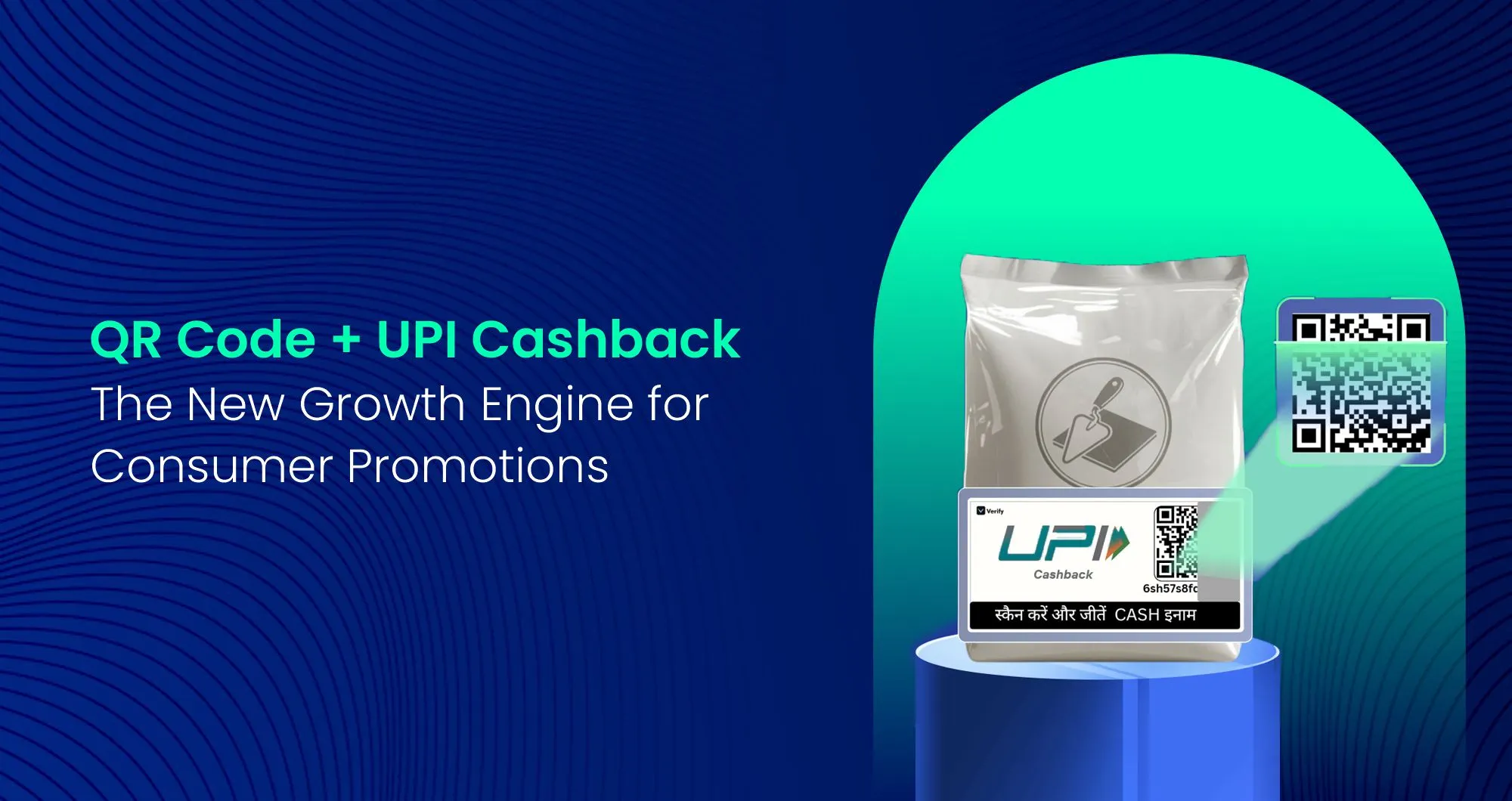
This is the part that genuinely changes consumer psychology. In a well-built QR code cashback journey, the consumer scans the code on the pack, the system verifies the product, and the cashback lands directly in their UPI-linked bank account, often within 15 seconds. They're still standing in the shop, or still unpacking the product at home. The reward and the purchase happen almost as one event in the consumer's mind. That immediacy is what marketers mean when they talk about reinforcement loops, and it's very hard to replicate with any delayed-redemption mechanic.
There's no app, no login, no waiting
The best implementations of this mechanic run entirely in a mobile browser. The consumer scans, the system auto-fetches basic KYC details, and the payout is triggered, no app download, no account creation, no OTP fatigue. Every barrier removed here directly translates into higher redemption rates.
It doubles as brand protection
Because each QR code is unique and tied to a specific unit, the same scan that triggers the reward can also verify that the product is genuine before releasing any payout. For categories where duplication and grey-market stock are a genuine business problem, tying QR code marketing to authentication turns a promotional campaign into an anti-counterfeit tool at the same time, at no extra cost to the brand.
It quietly builds a first-party data asset
Every scan tells a brand who bought the product, where, and which SKU. Do this at scale over a few campaigns, and you have something most FMCG brands have never had before: a real, first-party, location-and-product-level view of consumer demand, not a survey sample, not a distributor's estimate, but actual scan data. That data can shape where the next campaign runs, which SKU needs a push, and which markets are underperforming.
Consumer Promotion Ideas Built Around QR + UPI Cashback
1. Scan and Win, without the "did I actually win?" doubt
The classic scan-and-win format still works as a concept; the problem was always execution. Older versions asked consumers to scan, wait, and hope a prize would materialize eventually. The modern version pays out a guaranteed micro-cashback on every single scan, with occasional bonus payouts layered on top. Removing the uncertainty is what keeps consumers scanning the next pack too.
2. Milestone-based rewards that build a habit
Instead of a flat cashback on every scan, reward consumers on a rising scale, a little more on the 3rd scan, more again on the 5th, a meaningful bonus on the 10th. This turns a one-time buyer into someone actively tracking their progress toward the next reward, which is a far stronger pull toward repeat purchase than a flat, one-time incentive.
3. Festive and seasonal bursts
Layering a limited-time bonus cashback on top of a standing scheme during festive periods, Diwali, back-to-school, wedding season, creates urgency exactly when competitive intensity is highest. A visible "extra cashback this week only" message can meaningfully shift purchase timing in your favour.
4. Geo-targeted cashback values
Because every scan carries location data, brands can run different cashback amounts in different markets from within a single national campaign, higher incentives in markets where they're fighting for share, standard incentives where they already lead. No separate creative, no separate scheme, just smarter allocation of the same budget.
5. Basket-building through bundled scans
Reward consumers extra for scanning more than one product from the portfolio within a set period. This nudges single-SKU buyers toward exploring adjacent products, useful for brands trying to build volume behind a newer product sitting alongside an established hero SKU.
6. Retailer-assisted redemption
In trade-heavy categories, involve the retailer in the loop, some brands reward both the consumer and the retailer for a completed scan at the counter. This turns the retailer into an active participant encouraging scans, rather than a passive bystander to a scheme they have no stake in.
What Actually Separates a Good Campaign From a Forgettable One
Having the right idea is only half the job. The execution details are what decide whether a campaign gets an 85% scan rate or a 2% one. A few things matter more than anything else:
What matters | Why it matters |
Payout speed | Cashback that takes days to arrive loses the psychological "reward loop" entirely |
No app required | Every install step removes a large share of potential participants |
Duplicate detection | A code that can be scanned twice invites fraud and drains scheme budgets |
Real-time dashboards | Brands need to see scans and redemptions live, not in a monthly report, to react mid-campaign |
Tax compliance | Reward payouts need to handle TDS automatically, not leave it for manual reconciliation later |
Brands that get these operational details right consistently see redemption rates several multiples higher than brands running the same idea with a clunkier back-end.
Frequently Asked Questions
Is QR code cashback more effective than traditional scratch card promotions?
Generally, yes, largely because of speed and simplicity. Instant, verified payouts remove the uncertainty and effort that cause most scratch card and SMS-based schemes to see very low actual redemption, even when scan or purchase numbers look healthy on paper.
Do consumers need to download an app to redeem a QR code cashback offer?
Not with a well-built implementation. The strongest versions of this mechanic run entirely through a mobile browser, so there's no app download or account creation required before a consumer can redeem their reward.
Can QR code promotions help prevent counterfeit products?
Yes. Because each code is unique to a single unit, the same scan used for a promotion can also confirm the product is genuine before any reward is released, giving brands anti-counterfeit protection alongside consumer engagement.
What kind of data can brands get from a QR code cashback campaign?
Typically, product-wise and location-wise scan data in real time, showing which SKUs are moving, in which markets, and how consumers are responding to a given campaign as it runs, not weeks after it ends.
How Verify App Powers This for Brands
At Verify App, this is the exact problem we built our platform to solve: turning a simple product scan into an instant, verified, UPI-based cashback reward in under 15 seconds, with no app download required. Brands running campaigns on our platform have recorded scan rates of over 85%, well above the 1-5% typically seen with older app-based loyalty systems, along with measurable lifts in repeat purchases and overall sales. The system also automatically captures product- and location-level consumer data, so every campaign feeds directly into planning the next one.
If you're planning a QR code-based consumer promotion, get in touch with our team for a live demo and see how quickly you can go from idea to launch.

Verify App Editorial Team

Growth Marketing Specialist
We are a team of product experts, compliance professionals, and growth specialists dedicated to creating secure, scalable, and data-driven customer engagement solutions. With practical experience in UPI-based loyalty programs, CRM integrations, and digital verification tools, the team provides clear and actionable insights that help businesses build customer trust, increase retention, and improve operational efficiency. Every article is supported by industry research and real-world examples from both Indian and global markets.
Connect With Our Experts Today!
Latest posts
Discover other pieces of writing in our blog