Back
The Ultimate Guide to UPI-Powered Loyalty Programs for Brands in India
A complete guide to UPI loyalty programs in India, how a UPI cashback platform works, and what to look for in a digital loyalty platform for brands.
Loyalty programs in India have gone through several phases: physical punch cards, SMS-based coupons, app-based points systems, and now, UPI-powered rewards. Each phase solved a piece of the problem but left gaps in speed, cost, or consumer adoption. A UPI loyalty program is the current stage of that evolution, and it's worth understanding in detail before deciding whether it's the right fit for your brand.
This guide covers what a UPI-based loyalty program actually is, how it works operationally, why it has become the preferred model for consumer and channel rewards in India, and what to evaluate before choosing a UPI cashback platform or broader digital loyalty platform India brands can depend on long-term.
What Is a UPI Loyalty Program?
A UPI loyalty program is a rewards mechanism where consumers, retailers, or channel partners earn cashback that is paid directly into their bank account via UPI, instead of receiving points, vouchers, gift cards, or physical prizes. The reward is typically triggered by a specific action, scanning a QR code on a product, hitting a purchase target, or completing a defined milestone, and the payout happens through India's UPI rails, usually within seconds to a few minutes of the action being verified.
This is different from a traditional points-based loyalty program in one fundamental way: there is no intermediate currency. In a points system, a consumer earns points, which they must later redeem for a reward, often through a separate app or portal, and often only once they've accumulated enough points to make redemption worthwhile. A UPI loyalty program skips that intermediate step entirely. The reward is real money, in the recipient's own bank account, immediately.
How a UPI Cashback Platform Works, Step by Step
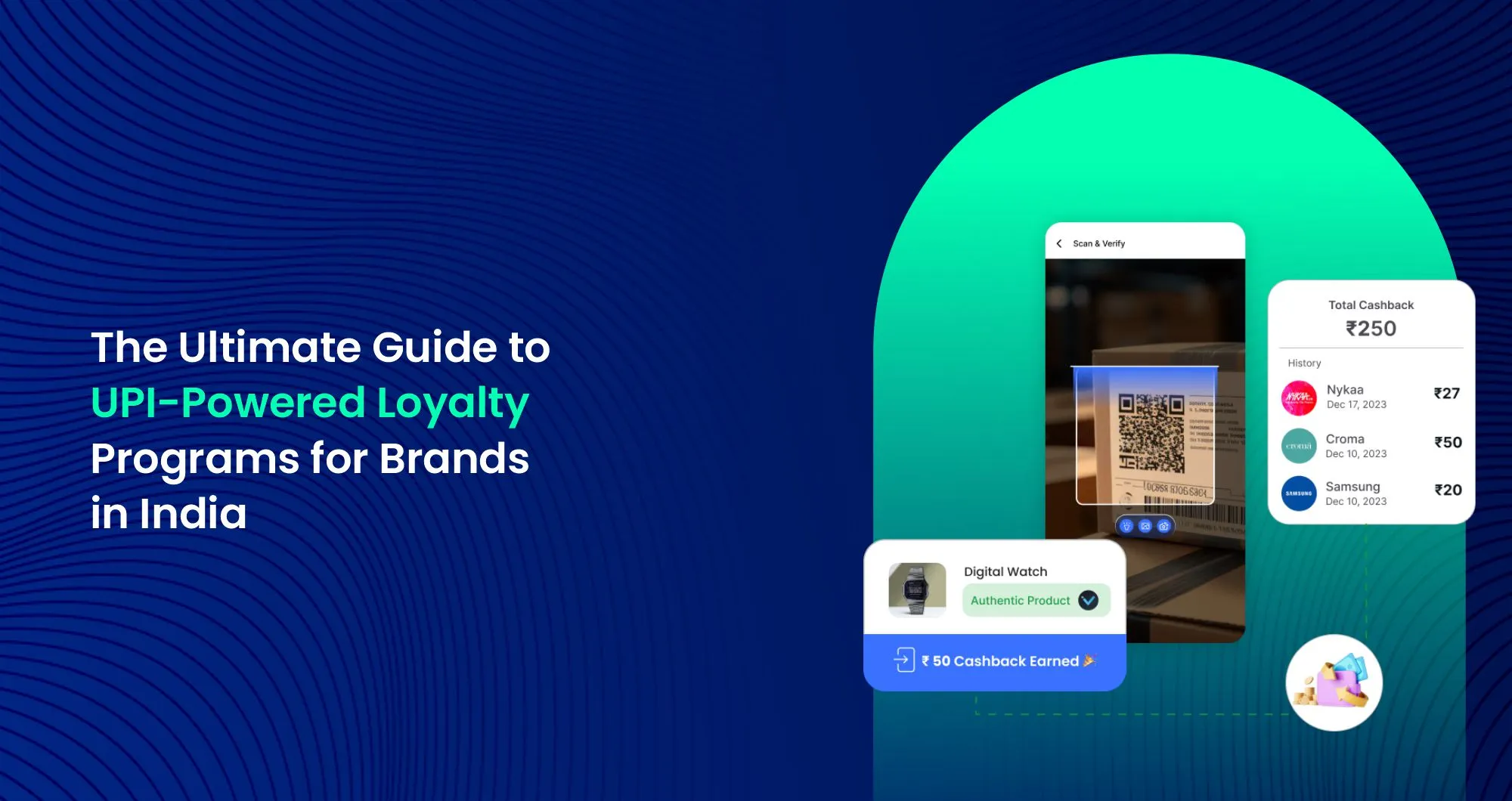
Most UPI-based reward systems in India follow the same basic flow, even though features vary by provider.
Step 1: A unique code is created. Usually, a QR code is printed on the product, sometimes a scratch code or a code sent via SMS or a receipt.
Step 2: The participant scans the code. This works directly in a mobile browser, no app needed.
Step 3: The system verifies the code and the person. It checks the code hasn't been used before and confirms the participant's identity, often auto-fetching basic KYC details.
Step 4: The cashback amount is calculated. This could be a flat amount, a milestone-based amount, or a value tied to a specific product or campaign.
Step 5: The money is paid out via UPI. It moves straight from the brand's account to the participant's UPI ID, usually within 15 seconds to a couple of minutes.
Step 6: The data is logged on the brand's dashboard. Brands can instantly see who redeemed what, where, and when.
Why Brands in India Are Moving to UPI-Based Loyalty
1.Familiarity removes the biggest adoption barrier
UPI is now the default way most Indians move money, whether paying a shopkeeper, a friend, or an online store. Asking a consumer or retailer to scan a QR code to receive money instead of sending it is a small behavioural shift, not a new skill. This familiarity is a major reason UPI-based schemes see far higher participation than app-based or points-based alternatives, which require entirely new habits.
2.Speed changes the psychology of the reward.
A reward that arrives within seconds of the qualifying action creates a much stronger association between the action and the benefit than a reward that arrives days or weeks later. This is a well-documented principle in behavioural reinforcement, and it applies directly to loyalty scheme design. Brands consistently report that instant payout schemes drive noticeably higher repeat participation than delayed-redemption schemes running the same underlying offer.
3.Lower operational cost than physical or points-based alternatives
Physical gifting, scratch cards, and voucher-based systems all carry logistics costs, printing, distribution, redemption processing, and often significant wastage from unclaimed rewards. A digital, UPI-based payout removes most of this overhead. Brands typically see a lower total cost per successful redemption compared to physical reward mechanics, even after accounting for platform fees.
4.Real-time data as a byproduct of every transaction
Every UPI-based redemption generates a data point: who participated, what product or action triggered it, where they were located, and when it happened. This turns a loyalty program into a live source of market intelligence, not just a cost center. Brands can see which regions or SKUs are underperforming and adjust campaigns mid-cycle rather than waiting for a quarterly review.
5.Compliance is built into the payout, not bolted on afterward.
Reward payouts in India are subject to TDS under Section 194R for benefits provided to business associates, and brands running manual or informal reward schemes often struggle to track and deduct this correctly. A well-built digital loyalty platform in India handles this calculation and deduction automatically as part of the payout process, reducing the compliance burden on the brand's finance team. This is one of the clearest signs of a mature digital loyalty platform India brands can rely on at scale.
Types of UPI Loyalty Programs Brands Can Run
1) Consumer-facing scan and win programs
Consumers scan a QR code on a purchased product and receive instant cashback, often used for new product trials, festive promotions, or ongoing engagement campaigns.
2) Retailer and dealer incentive programs
Retailers and dealers scan codes tied to stock they've sold or purchased, earning cashback that scales with volume, encouraging active sell-through rather than passive stocking.
3) Channel and distributor target-based schemes
Larger channel partners are rewarded against monthly or quarterly targets, with milestone-based payouts that increase as targets are met or exceeded.
4) Influencer and trade professional rewards
Painters, electricians, plumbers, and contractors, who influence brand choice at the point of application, are rewarded directly for using or recommending a specific brand, rather than relying on the reward trickling down through a distributor.
5) Employee and internal incentive programs
Some brands extend the same UPI-based mechanic internally, rewarding sales teams or field staff for hitting targets, using the same instant-payout logic that works for external audiences.
What to Evaluate in a UPI Cashback Platform or Digital Loyalty Platform in India
Not all platforms offering UPI-based rewards are built the same way. A few factors matter significantly when evaluating a provider:
a) Payout speed and reliability. Ask specifically how long a payout takes end-to-end, and what happens when a payout fails or is delayed. A platform that claims instant payouts but frequently has delays defeats the purpose of the mechanic.
b) No-app, browser-based consumer journey. Confirm that participants can redeem without installing an app. This single factor has an outsized impact on redemption rates.
c) Fraud and duplicate detection. The platform should prevent the same code from being redeemed more than once, and should have mechanisms to detect unusual redemption patterns that suggest gaming of the scheme.
d) Real-time dashboard and reporting. Brands should be able to see scan and redemption data live, filtered by product, region, and time period, not through delayed exports.
e) Auto-KYC and data capture. A platform that automatically fetches basic identity details on first redemption reduces friction for participants and gives brands cleaner first-party data.
f) TDS and tax compliance handling. Given the regulatory requirement under Section 194R, the platform should handle deduction and reporting automatically rather than requiring manual calculation after the fact.
g) Flexibility across program types. A platform limited to a single reward structure, flat cashback only, for example, restricts a brand's ability to run milestone-based, SKU-targeted, or region-specific campaigns as needs evolve. This flexibility is often the clearest difference between a basic payout tool and a genuine digital loyalty platform. Indian brands can scale across multiple product lines.
h) Multi-brand and multi-user support. For companies managing several brands or a large regional sales team, the platform should support multiple brands and team members within a single account without requiring separate setups.
Common Mistakes Brands Make When Launching a UPI Loyalty Program
1) Treating it as a one-time campaign rather than an ongoing relationship. The strongest results come from programs that run continuously, with milestone structures that reward sustained engagement, not just a single burst campaign with no follow-through.
2) Ignoring the onboarding experience for the first redemption. If a participant's first scan is confusing or slow, they're unlikely to try again. The first interaction needs to be as frictionless as every subsequent one.
3) Underestimating the value of the data being captured. Many brands set up a UPI cashback platform purely for the reward mechanic and never actually use the scan and location data it generates to inform other business decisions.
4) Not adjusting reward values by region or product. A flat, one-size scheme across the country often overspends in low-competition markets and underperforms in high-competition ones. Regional and SKU-level flexibility is worth the added setup effort.
5) Overlooking compliance until it becomes a problem. TDS obligations on reward payouts are a genuine regulatory requirement, not an optional detail, and retrofitting compliance after a scheme has already run creates unnecessary risk.
Frequently Asked Questions
1) What is a UPI loyalty program?
A UPI loyalty program is a rewards system where consumers, retailers, or channel partners earn cashback paid directly into their bank account via UPI, triggered by an action like scanning a QR code, hitting a purchase target, or completing a milestone, instead of earning points or vouchers that need separate redemption.
2) How is a UPI loyalty program different from a points-based loyalty program?
A points-based program requires participants to accumulate points and redeem them later, often through a separate app or portal. A UPI loyalty program skips that step entirely; the reward is real money paid directly to the participant's bank account, usually within seconds of the qualifying action.
3) How fast does a UPI cashback platform actually pay out rewards?
Most well-built platforms complete payouts within 15 seconds to a couple of minutes of verification, depending on the platform's infrastructure and bank processing times. Payout speed is one of the most important factors to check before choosing a provider.
4) Do participants need to download an app to use a UPI cashback platform?
No, not with a well-designed platform. Most modern UPI-based reward journeys work entirely through a mobile browser, since requiring an app download significantly reduces participation.
5) Is a UPI loyalty program subject to TDS in India?
Yes. Reward payouts to business associates, such as retailers, dealers, or trade influencers, are subject to TDS under Section 194R. A reliable digital loyalty platform India brands use should calculate and deduct this automatically as part of the payout process, rather than leaving it to manual reconciliation later.
6) Can a UPI loyalty program be used for both consumers and channel partners?
Yes. The same underlying mechanics- scan, verify, and pay out instantly via UPI- can support consumer promotions, retailer and dealer incentive schemes, distributor target programs, and rewards for trade influencers like painters, electricians, and plumbers, often on a single platform.
7) How long does it take to launch a UPI cashback platform for a brand?
With a plug-and-play, QR-code-based system, many brands can go from setup to a live scheme within about a week, since there's no dedicated app to build and no physical reward logistics to manage.
How Verify App Supports UPI-Powered Loyalty Programs
Verify App is a digital loyalty platform in India built specifically around instant, UPI-based rewards for consumers, retailers, distributors, and trade influencers. The platform supports QR-code-based scan and cashback journeys, milestone and target-based schemes, SKU and region-level targeting, automatic KYC, duplicate detection, and TDS-compliant payouts, all accessible through a real-time dashboard. Brands can typically go from setup to a live scheme within about a week, without building a dedicated app or managing physical reward logistics.

Verify App Editorial Team

Growth Marketing Specialist
We are a team of product experts, compliance professionals, and growth specialists dedicated to creating secure, scalable, and data-driven customer engagement solutions. With practical experience in UPI-based loyalty programs, CRM integrations, and digital verification tools, the team provides clear and actionable insights that help businesses build customer trust, increase retention, and improve operational efficiency. Every article is supported by industry research and real-world examples from both Indian and global markets.
Connect With Our Experts Today!
Latest posts
Discover other pieces of writing in our blog